
How to Stop Over-Engineering Your Multi-Year Pavement Plan
It’s a scenario every public works director, city engineer, and pavement manager knows all too well: you’re presenting a multi-year Pavement Management Program to council or executive leadership, and someone pauses on a segment scheduled four years out to ask about specific ADA ramp upgrades, drainage fixes, or local detour routes.
It’s an understandable reaction—decision-makers want pinpoint accuracy before committing capital dollars. However, demanding project-level engineering precision inside a network-level pavement plan is one of the fastest ways to paralyze your department and waste valuable staff hours.
To build an efficient, cost-effective pavement management pipeline, you have to draw a clear boundary between Network-Level strategy and Project-Level execution.
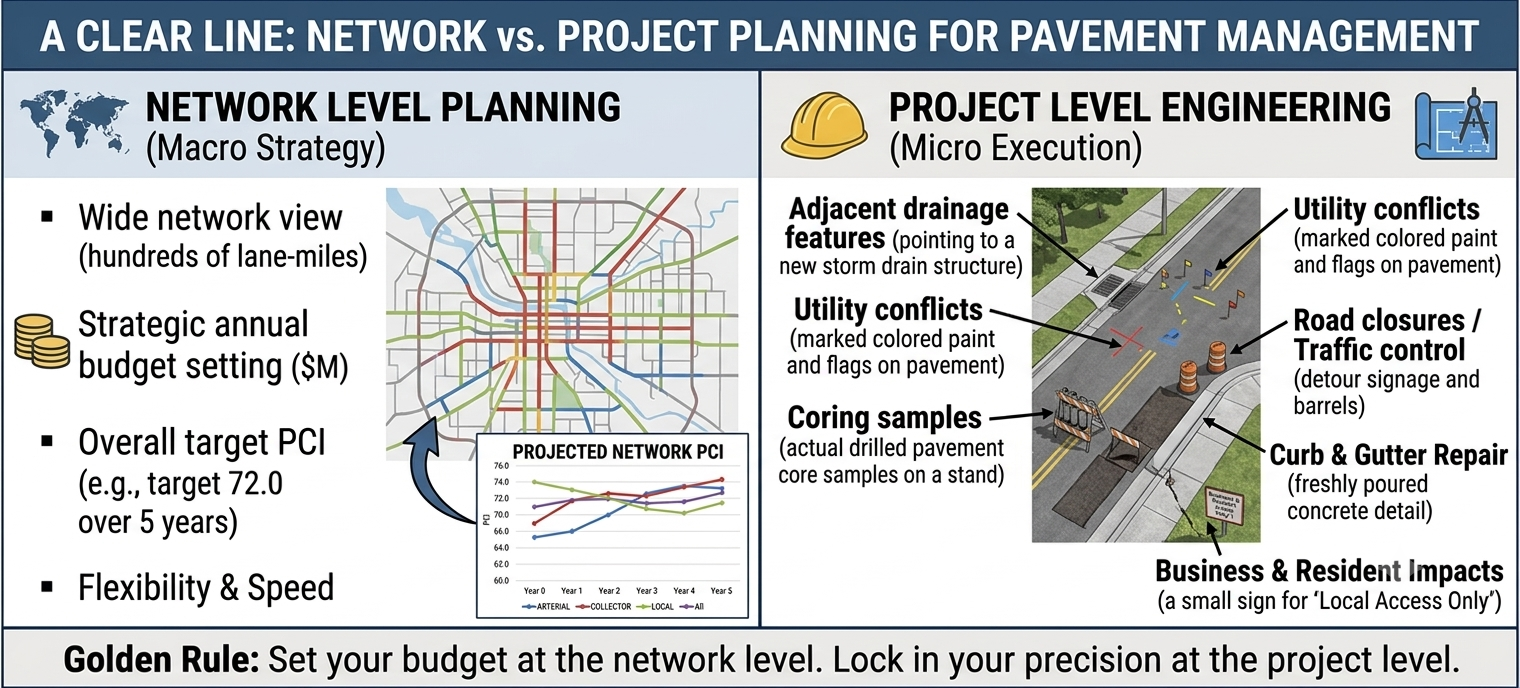
The difference between network planning and project planning
The Efficiency Trap: Too Much Detail Too Soon
Wanting high precision early on feels like responsible asset management. But applying project-level design logic to long-term network modeling is counterproductive.
Pavement degrades dynamically. If you spend dozens of hours calculating exact asphalt tonnages, utility adjustments, and traffic control plans for a mill-and-overlay scheduled three years from now, those assumptions will likely be obsolete by the time the crew arrives. Inflation fluctuates, weather speeds up pavement distress, and utility companies cut into the road you planned to preserve.
Trying to solve micro-level engineering problems during multi-year network modeling doesn't lower risk—it just slows down strategy and drains your energy.
Side-by-Side: Macro Strategy vs. Micro Execution
While network and project planning inform one another, they serve fundamentally different purposes in pavement management and require entirely different mindsets.
| Planning Dimension | Network-Level Pavement Planning | Project-Level Pavement Engineering |
|---|---|---|
| Primary Goal | Establish annual budgets, target overall PCI, and set multi-year paving strategies | Deliver a precise, constructible, and bid-ready engineering design |
| Scope | Entire road network (hundreds or thousands of lane-miles) over 5–10+ years | Specific road segments, corridors, or localized treatments |
| Key Inputs | Automated distress data, PCI ratings, deterioration curves, budget caps | Coring samples, adjacent drainage, utility conflicts, curb & gutter repairs |
| Community Impact | General level of service and long-term taxpayer value | Local business access, resident disruptions, temporary traffic control |
| Core Tradeoff | Prioritizes speed, flexibility, and scenario modeling | Prioritizes accuracy, contract certainty, and detail |
The Core Tradeoff: Flexibility vs. Precision
Understanding what each level does best helps keep your pavement program agile:
Network Level = Speed & Flexibility: Network planning needs to be dynamic. It allows you to run "what-if" budget scenarios instantly—showing stakeholders what happens to overall network health if funding is cut by 15% or if you pivot from heavy reconstruction to proactive slurry seals.
Project Level = Precision & Constraint: Project planning is where you lock down variables. It requires dedicated engineering time to dot every i and cross every t, ensuring contractors have exact specs so you avoid costly change orders during construction.
The Golden Rule for Pavement Managers
To keep your team efficient and stretch every infrastructure dollar further, keep each phase in its proper lane:
Set your budget and high-level strategy at the network level. Lock in your engineering accuracy at the project level.
Use your network-level Pavement Management System (PMS) to answer: "How much funding do we need to maintain our average PCI, and which general corridors need attention first?"
Once that baseline budget is secured, hand off those candidate segments to project-level engineering to answer: "How do we design this specific corridor to stay strictly under budget while managing drainage, detours, and local impacts?"
By respecting this line between macro strategy and micro execution, you'll save time, protect your staff resources, and build a far more resilient pavement program.