
The Hidden Cost of Bad Roads: Why Waiting to Repair Is So Expensive
The Real Problem Isn’t Bad Roads — It’s Timing
It’s true that most cities struggle because they lack funding. But most of their struggle is actually because they act too late. By the time a road “looks bad,” the cost to fix it has already skyrocketed.
The Pavement Deterioration Curve
Roads don’t fail linearly — they fail exponentially.
Years 1–10: Slow deterioration
Years 10–15: Rapid decline
After that: Structural failure
And the costs increase proportionally. Here is what that looks like on the deterioration curve of a road:
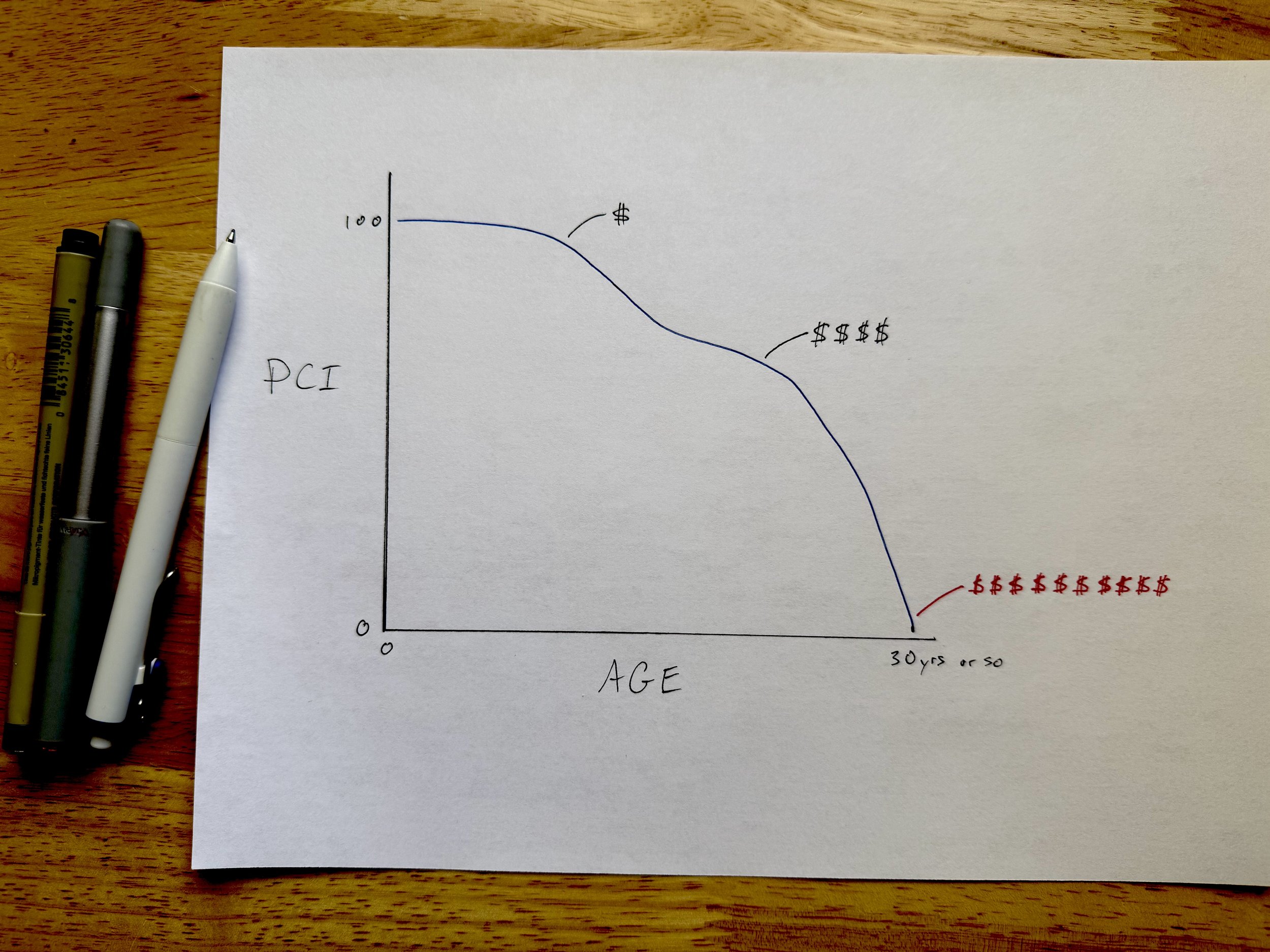
Deterioration curve of a road. It’s much cheaper to maintain at the top of the curve (good PCI) than at the bottom (failed road)
A Simple Cost Example
Let’s say a city has a one-mile road:
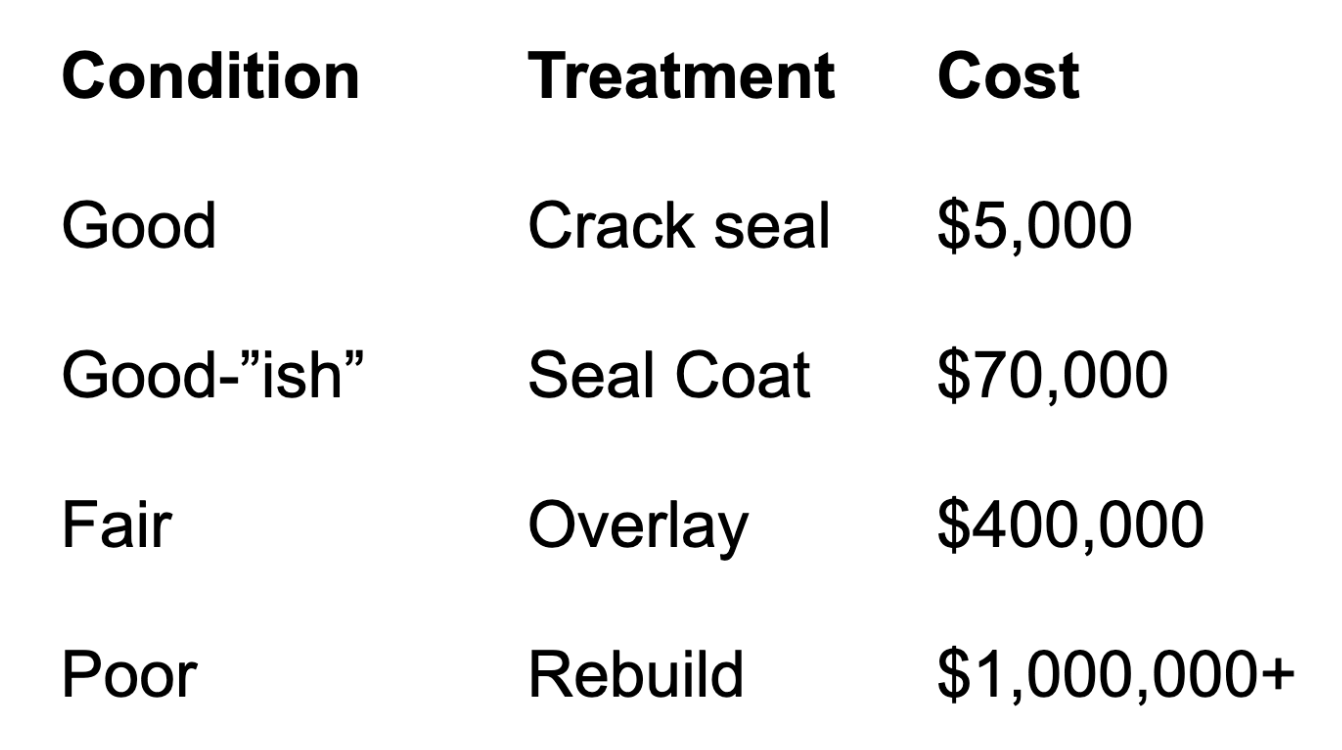
Because it costs so much to fix a failed road, a City can fall into the “Worst First” curse, where they forgo maintaining 2 fair roads or 20 good roads to reconstruct a single bad road. Here’s what that looks like from a PCI (Pavement Condition Index) distribution perspective:
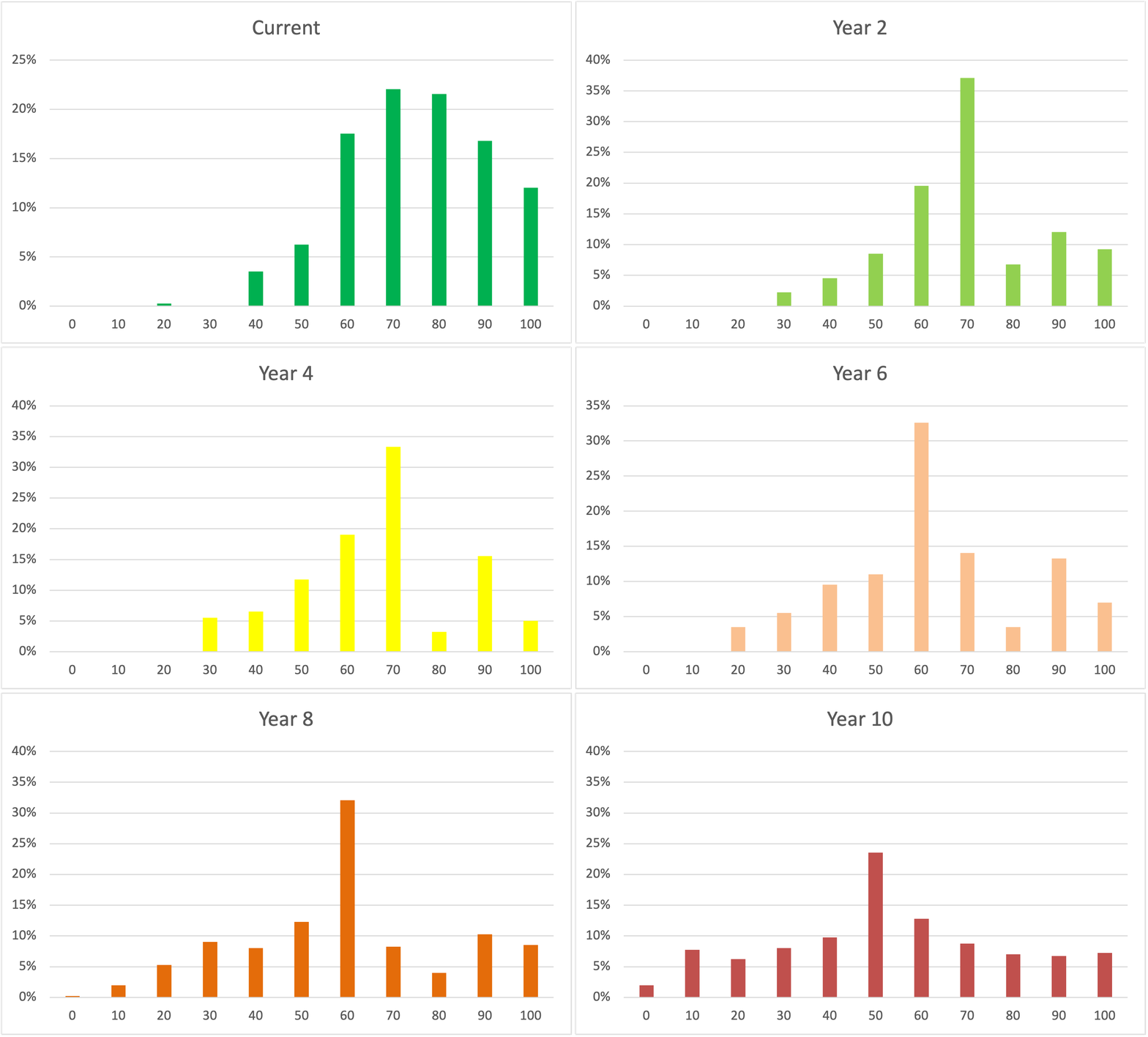
You can see how a city with a majority of good roads falls into this trap. As they fix all the worst roads, the good roads turn bad, and eventually there are too many bad roads and not enough budget.
Why Cities Fall Behind
This isn’t anyone’s fault. Cities fall behind because asphalt roads are relatively new. Modern asphalt paving was only invented 150 years ago. And the US spent the last 70 years building the largest public road network in the history of the world but didn’t really know how long those roads would last or that we would be putting sewers, waterlines, power and fiber under them. So no one set aside enough money to maintain all those roads once they were built, therefore many city leaders today are inheriting crumbling road infrastructure. But there are things that perpetuate the cycle, such as:
Lack of current condition data
Infrequent inspections (every 3–5 years)
Budget decisions based on complaints, not data
This leads to reactive maintenance cycles. You can’t optimize what you can’t measure. Without consistent quality data, good roads get ignored, bad roads get over-prioritized, and budgets get misallocated, which is a slow death spiral for a road network.
The Smarter Approach: Preventive Maintenance
Leading agencies focus on:
Maintaining roads in “good” condition
Applying low-cost treatments early
Using data to guide decisions
This approach extends pavement life, reduces long-term costs, and improves network-wide conditions (with sufficient budget).
How Technology Changes the Game
In the past, collecting good pavement quality data was a slow, expensive, process that was hard to get accurate. Modern systems allow cities to:
Collect accurate and highly detailed data quickly
Detect deterioration early
Use that data to plan
Instead of guessing, agencies can optimize every dollar spent and understand the implications of budget decisions instantly.
Where GoodRoads Comes In
GoodRoads is designed specifically for this use case: evolving from a worst-first city to a proactive, preventive-maintenance city. Our pavement assessment and planning technology enables:
Rapid, scalable road condition data collection
AI-powered analysis with built-in quality control
Actionable maintenance planning
This helps cities move from: 👉 Reactive → Predictive → Optimized
The biggest cost in road maintenance isn’t asphalt. It’s waiting too long to act.If your city hasn’t assessed its roads recently, you’re likely overspending.
Contact us at GoodRoads to learn how we can help you reduce costs and extend pavement life.