
The $20,000 Rule: How Much Does It Really Cost to Maintain City Roads?
Every city manager and public works director has asked some version of this question: If we spend X on roads this year, what happens? The honest answer is that it depends — on your road network, your starting condition, your goals, and your methodology. But we can model it.
Using GoodRoads' pavement management tools, we ran a citywide PCI projection across a wide range of annual budget levels — from $0/mile all the way up to $300k/mile. The modeling uses non-overlapping treatment methodologies that together cover the full 0–100 PCI (or 1–10 PASER) spectrum, meaning every road gets the right treatment for its condition. All figures include a 15% contingency and do not account for inflation.
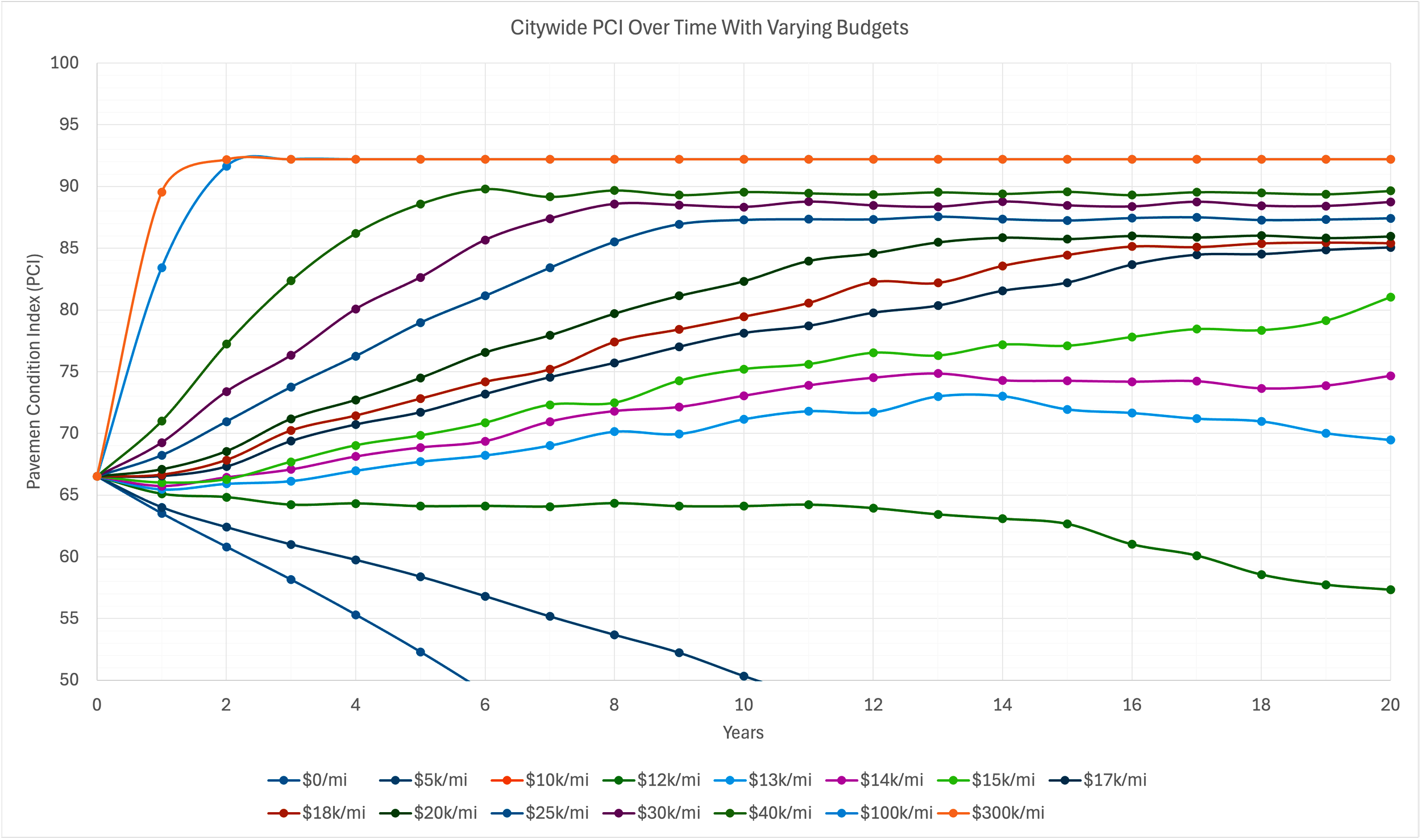
A distribution of average pavement ratings over 20 years with varying annual budgets
The results are shown in the chart above.
The Rule of Thumb Holds Up
Pavement Management expert, Steve Lander of Pavement Navigators often cites $20,000 per centerline mile as a solid starting point for a municipal road budget. Looking at the chart, that guidance plays out well — the $20k/mi scenario produces a meaningful, sustained improvement in citywide PCI over 20 years without requiring heroic capital investment.
That said, "good" is relative.
It Depends on Your Goals
If a jurisdiction sets a specific PCI target — say, maintaining an average of 75 or better — this chart makes it straightforward to identify the budget level that gets you there and keeps you there. The curves flatten out as networks reach a steady state, which is exactly what you want to see in a well-funded program.
But in practice, no city just picks a PCI number and calls it a plan. Real decisions factor in things like:
Daily traffic volume and importance of specific corridors
Truck traffic and its outsized impact on pavement wear
Business districts and areas with economic or political priority
Community expectations and upcoming development
Grant eligibility windows and funding cycles
A pavement management plan is a tool for informing those decisions — not replacing them.
Your Starting Point Changes Everything
One of the most important things this chart illustrates is that where you start matters enormously. This network begins the projection at an average PCI of 66 — a "Fair" condition that requires consistent investment just to hold even, let alone improve.
A city starting at a PCI of 50 has a steeper hill to climb. More roads are already in the "Poor" or "Very Poor" range, where only expensive rehabilitation or reconstruction treatments apply. That means each dollar of budget gets stretched thinner just to arrest the decline, before any improvement can happen. A city starting at 84, by contrast, has mostly "Good" roads that respond well to low-cost preventive treatments — the budget goes further, and progress is faster.
In an upcoming post, we'll look at exactly that scenario: a higher-PCI network and how the math shifts. But before we get there, we need to build a foundation for why starting condition matters so much — and that means understanding the pavement aging curve. That's the subject of our next post.