
The Force Multiplier: Why Your Climate Dictates Your Maintenance ROI
In the world of pavement management, we often look for a "smoking gun" to explain why roads fail. Is it the trucks? Is it the weather? Or is it just time?
A 2020 study by Llopis-Castelló et al. titled “Influence of Pavement Structure, Traffic, and Weather on Urban Flexible Pavement Deterioration” provides a definitive answer: It’s a combination of all three, layered in a specific hierarchy.
The Hierarchy of Decay
The research establishes that road failure isn't random; it follows a predictable order of influence:
Age (The Foundation): Pavement age is the #1 predictor of overall quality (PCI).
Truck Traffic (The Heavy Hitter): Heavy loading is the primary cause of structural distresses, like deep fatigue and rutting.
The Environment (The Force Multiplier): Weather factors—snow, rain, and temperature swings—act as a catalyst. They take the existing stress from traffic and accelerate the aging process.
What the GoodRoads Data Reveals (By Region)
When we look at the average Pavement Condition Index (PCI) across our national network, the "Weather Tax" becomes visible. By grouping our client data by climate profile, we see how the environment forces different "Aging Curves" on different regions:
The "Midwest / Great Lakes"
Environmental Characteristics: Sustained sub-freezing winters, high moisture, heavy plowing.
Average Network PCI: 54 – 65
The "Intermountain North"
High snow depth, extreme seasonal temperature swings, frequent freeze/thaw.
Average Network PCI: 59 – 68
The "Coastal Southeast"
High annual rainfall and humidity, but stable/warm temperatures.
Average Network PCI: 78 – 88
The "Arid Southwest"
Extreme summer heat, but very low moisture and minimal temperature fluctuation.
Average Network PCI: 85 – 92
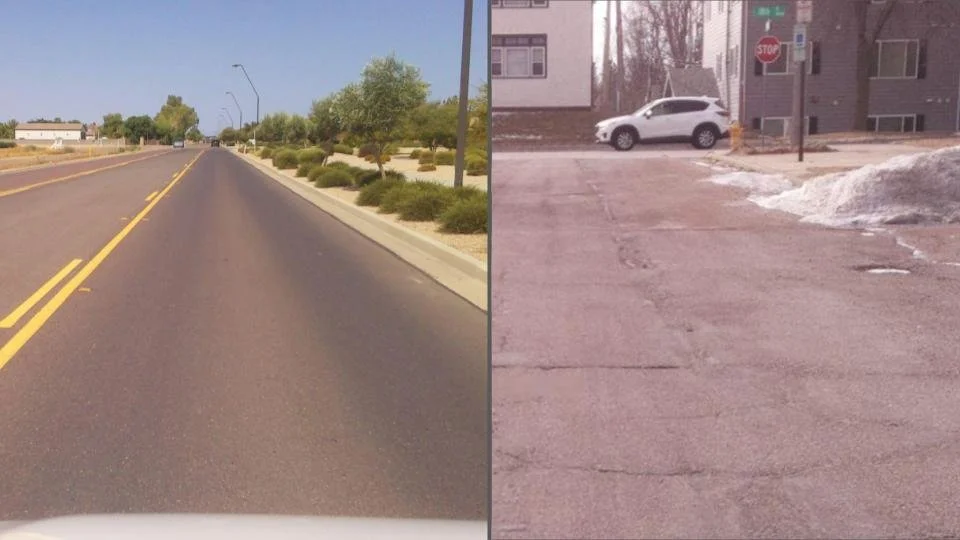
Dry and hot > freeze/thaw, very wet, or very cold in terms of pavement preservation
Spotlight: The Washington State "Lab"
Washington State is a perfect laboratory for this research because the state is split by the Cascades. We can compare agencies with similar traffic and age profiles but vastly different "Force Multipliers."
Our data shows that geography isn't destiny—good management can beat the environment—but the "Weather Tax" determines how hard you have to work to stay ahead:
The Volatility Factor (Inland/Eastern WA): In regions with intense summer heat and freezing winters, "pavement years" are essentially doubled. Extreme thermal expansion and contraction create micro-cracks that truck traffic quickly turns into structural failures. Here, the "Aging Curve" is a steep cliff.
The Moisture Factor (Coastal/Western WA): These agencies face a different battle: saturated subgrades. While they avoid the worst freeze-thaw cycles, high precipitation acts as a lubricant for traffic damage, "pumping" the road base and leading to failures from the bottom up.
The 6 Environmental Accelerators
The research identifies six specific factors that determine how fast your road "ages" under the pressure of truck traffic:
Temperature Fluctuation: The "breathing" of the pavement that leads to rapid fatigue.
Snow Depth: Mechanical stress from plows plus constant moisture.
Sitting around Freezing: The destructive power of the constant freeze/thaw cycle.
Average Temperature: How brittle (cold) or ductile (hot) the asphalt remains.
Lots of Heat: Softens binders, making the road more vulnerable to truck-induced rutting.
Rain: The silent killer of structural integrity in the subgrade.
Strategy Over Luck: Controlling the Curve
The takeaway is clear: If Age is the primary driver of PCI, then Pavement Preservation is your only defense. However, you cannot use a "Coastal" maintenance schedule for an "Inland" climate.
If your environment is a high-volatility "Force Multiplier," your window for inexpensive preservation is much smaller. Waiting just one extra year to seal cracks in a freeze-thaw zone can cost four times as much in reconstruction costs down the road.
At GoodRoads, we give you the data to see the "weather tax" in action. By identifying which segments are deteriorating faster than expected for their age and traffic load, you can pinpoint where environmental stressors are most aggressive. This visibility allows you to build a smarter preservation strategy and a budget that beats the aging curve—no matter what the thermometer says.
How fast are your roads aging? Get a data-backed look at your network's decline today and start planning for your regional climate.