
Most pavement management advice assumes you have enough budget to do the math properly. But many city managers I talk to are looking at a budget that covers maybe half of what their network needs, and they want to know: where do I put the money?
The answer isn't your worst roads. It's the roads where your dollars protect the most value. Those are different things, and confusing them is how cities spend their entire paving budget on roads that were already too far gone to save.
Condition Determines Leverage
The pavement aging curve isn't linear. Roads hold up reasonably well for years, then accelerate through a steep deterioration window, then bottom out in failure. Where a road sits on that curve determines what your dollar buys.
In the Good range (PCI 70+), preventive treatments — crack seal, high density mineral bond, chip seal, thin overlay — cost $3,000–$6,000 per lane mile and reset the clock by a decade. Let that road slide into the Fair range, and you're looking at rehabilitation. Let it go further and you're in reconstruction territory. The same road, three very different price tags.
This is why protecting your best roads comes first. It feels wrong to spend money on roads that aren't broken. But a chip seal on a PCI 74 road today might forestall a $40,000 rehab in ten years. That's not maintenance — that's the best investment in your budget.
The Cliff Roads Need a Decision
Every network has roads sitting in the PCI 58–65 range that are close to the edge — one bad winter or another deferred cycle away from crossing out of surface treatment territory. These roads don't need more patching. They need a decision.
Either fund a rehabilitation treatment in the next budget cycle, or formally accept that they're heading to reconstruction and start planning the capital funding. Leaving them in limbo while you patch potholes is the most expensive option. You're spending maintenance dollars on a road that needs capital investment while the capital cost keeps climbing.
Traffic Matters — With One Condition
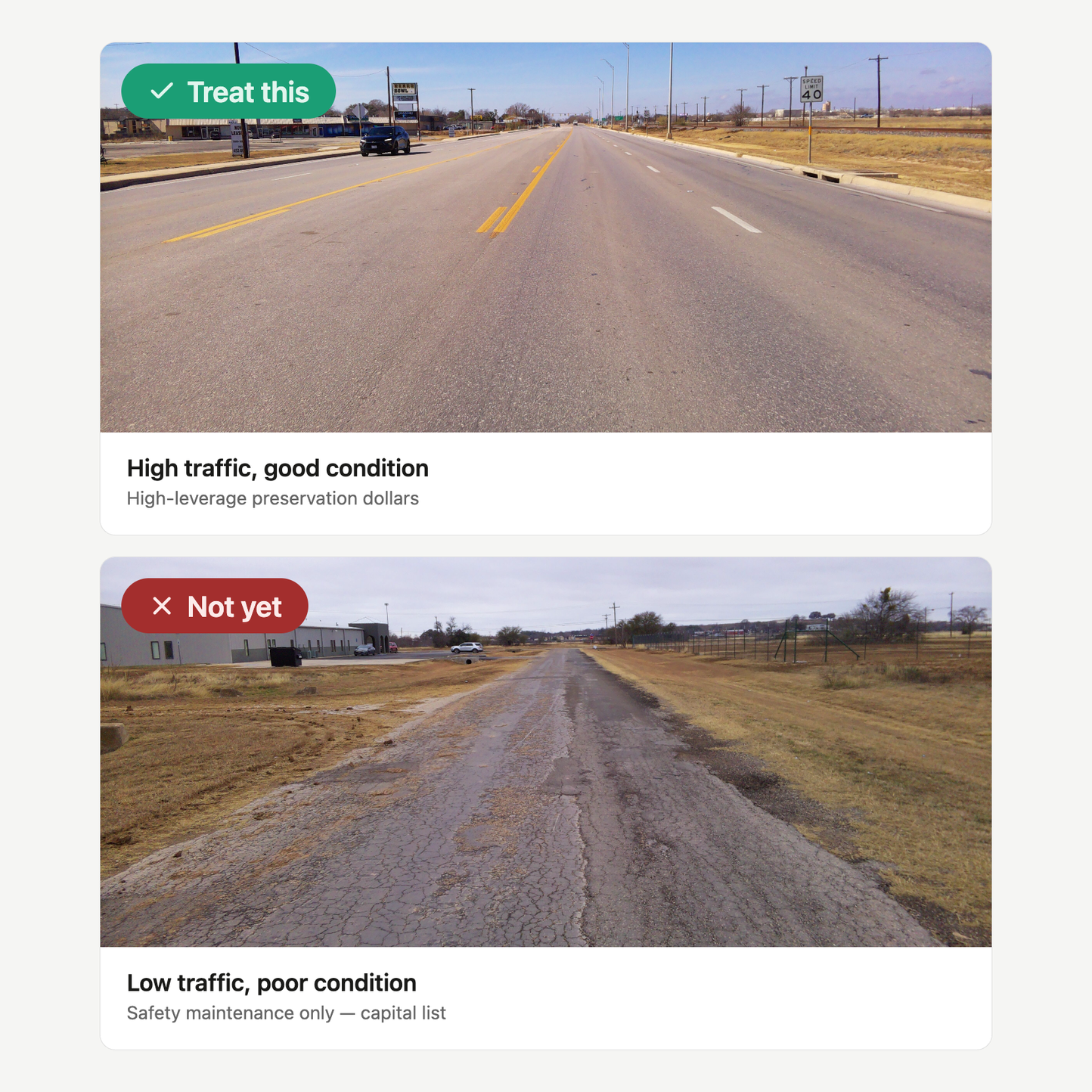
Within the same condition tier, traffic volume is the tiebreaker. A busy collector at PCI 71 gets treated before a quiet residential street at PCI 71.
Traffic can also elevate a Fair road above a Good one — but only when the Fair road still qualifies for a cost-effective surface treatment. A collector at PCI 63 that can take an overlay is a legitimate competitor for budget against a low-volume Good road. But once a Fair road has crossed into reconstruction territory, traffic doesn't change the math. You're no longer comparing similar treatment costs. Put it on the capital list and don't raid your preservation budget to address it.
Coordinate With Utility and Drainage Work
Before you finalize any priority list, check your utility and drainage project schedule. Paving over a road that's getting a waterline replaced in two years is money you'll watch get torn up. Conversely, a road already scheduled for utility work is a natural candidate to combine with a paving treatment — you're mobilizing equipment anyway, and a fresh trench patch in a newly paved road holds better than one in a deteriorated surface.
Storm drainage failures also accelerate pavement deterioration faster than almost anything else. A road with unresolved drainage problems isn't a good candidate for surface treatment until the water issue is addressed. You'll be treating the symptom while the cause keeps working.
Write Off Your Worst Roads (For Now)
Roads below PCI 40 are beyond your maintenance budget. Spreading maintenance dollars there doesn't fix them — it just slows the decline while drawing resources away from roads you can actually save. The right call is safety maintenance only: fill the potholes, address edge failures, manage drainage. Then put them on a capital reconstruction list and start finding the funding.
The Four Buckets
When budget is tight, sort before you spend:
Good condition roads: preventive treatment first, higher-volume roads first within this tier.
Fair condition roads with a viable surface treatment: traffic volume can tip these above lower-volume Good roads. Make the call.
Fair condition roads needing reconstruction: minimal safety patching. Capital list or funded rehab — pick one.
Poor or Very Poor condition roads: safety maintenance only. High traffic makes this more urgent politically, not financially.
That framework won't give you a 20-year projection or a council-ready budget number. But it will keep you from spending money in the worst possible places — and in a constrained environment, that's half the battle.
Finally, if your city is in this situation and you want an escape route, start with a comprehensive pavement assessment. From there you can calculate the needed budget and develop an escape plan.
Every road network is different. If you want to walk through what this looks like for your city specifically, reach out — that's exactly the kind of analysis we do at GoodRoads.