
What It Really Costs to Maintain a 56 PCI City vs. an 85 PCI City
In past posts, we looked at the aging curve and how it governs how hard or easy it is to move a city's average PCI by even a single point, depending on where that city sits on the curve. We used a 66 PCI city as our "average" example, since most cities land somewhere in the 70s, and found that moving the needle even one point took real money. But what happens at the extremes? What does the math look like for a city starting well below average or one sitting comfortably above it? Let's run the numbers.
Low PCI: Starting at 56
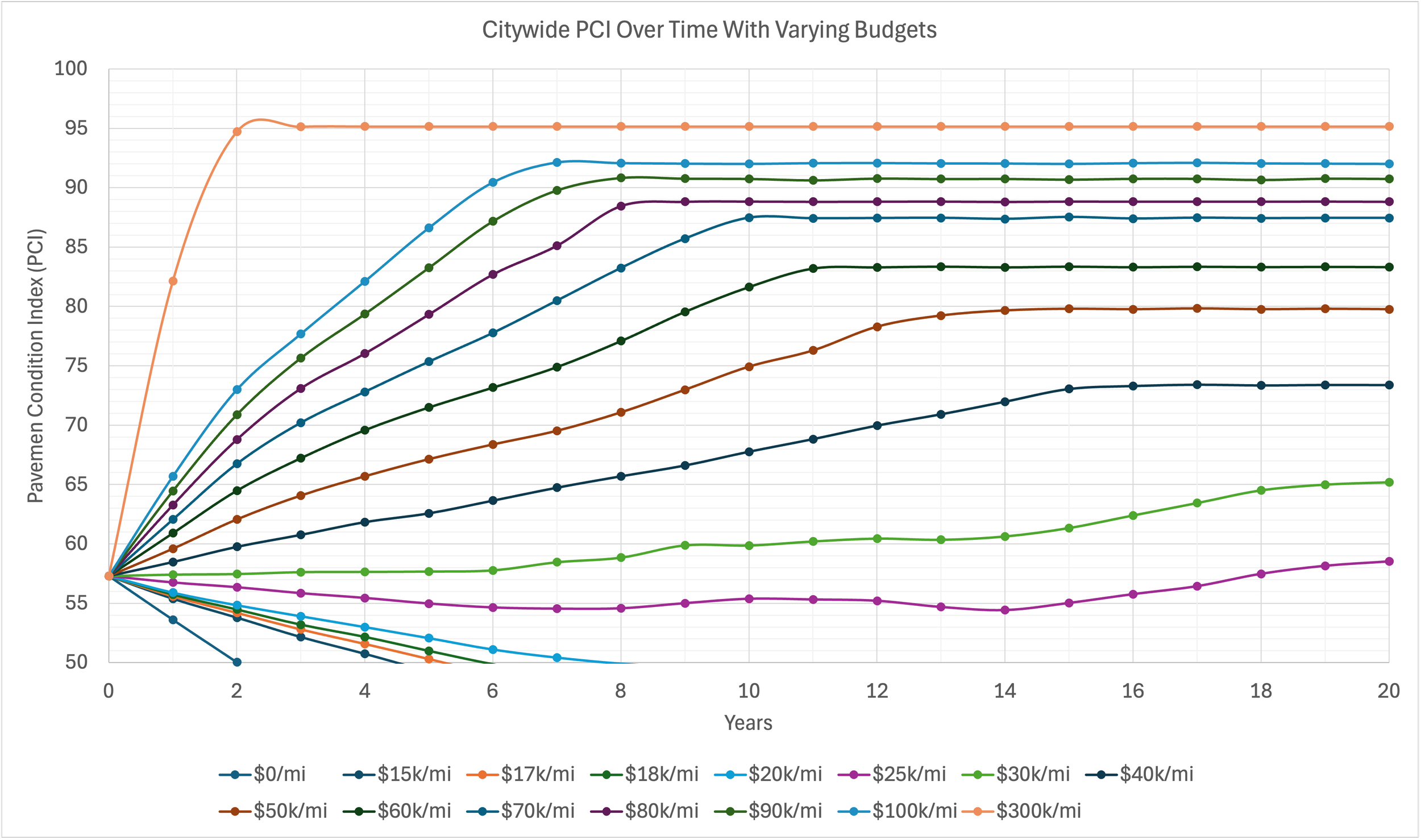
$30,000/mile to hold steady with a 56 PCI starting point
This city has an average PCI of 56. For our "average" 71 PCI city, $20,000 per mile per year was the magic number to hold steady. For a city starting at 56, that same budget isn't even close - anything below roughly $30,000 per mile sends the network sliding toward zero.
In other words, this city has to spend 50% more than the average city just to tread water. And if the goal is to climb back into the 70s? Spending has to double, to roughly $40,000 per mile per year.
High PCI: Starting at 85
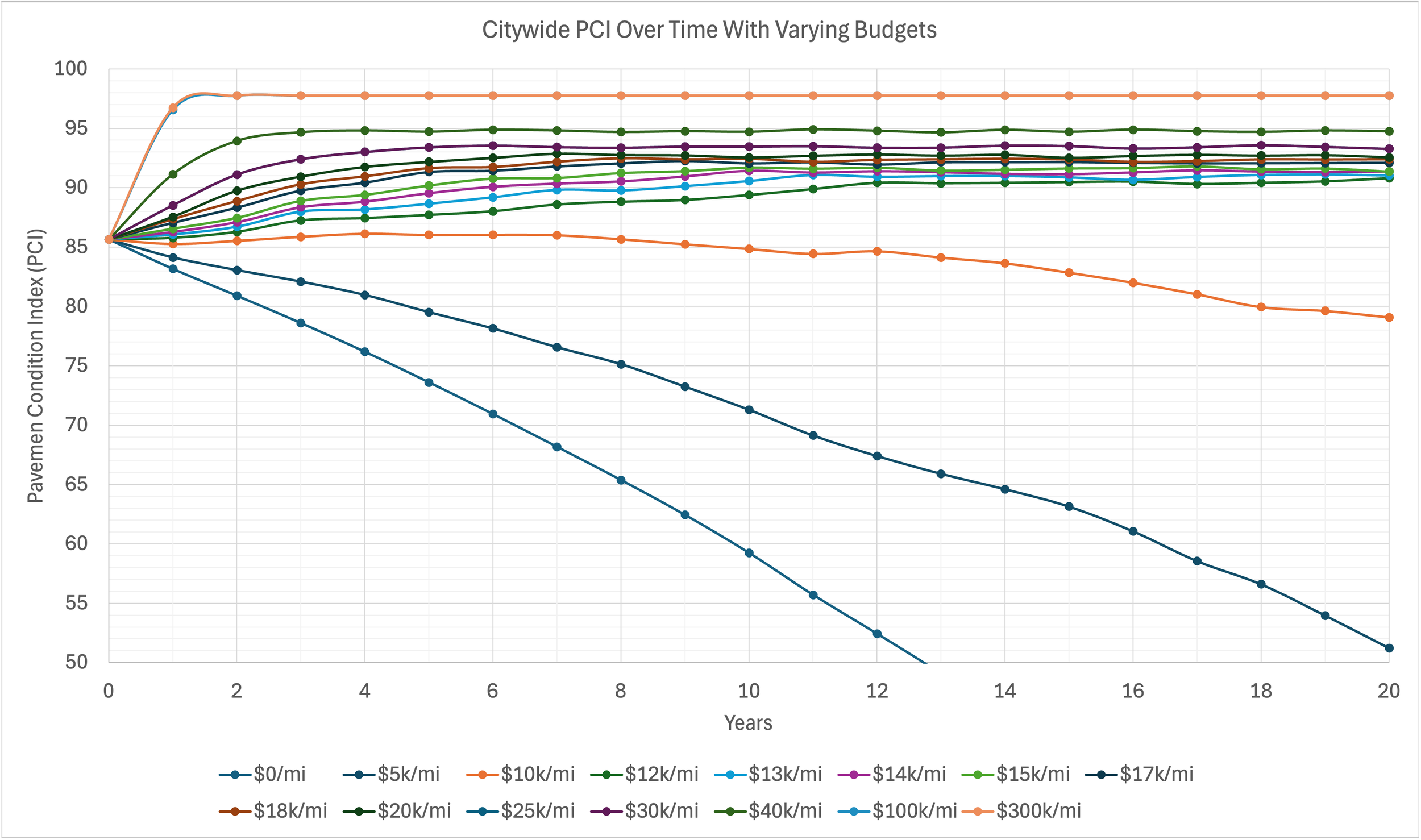
$12,000/mile is all you need when your citywide PCI is an 85
Now flip the script. A city sitting at a comparatively high PCI of 85 tells the opposite story: a little more than half of what the 70-PCI-range city needs (around $12,000 per mile per year) is plenty to hold steady at 85.
There's a ceiling, though, and it shows up in every scenario we've modeled: somewhere around 95 PCI, no amount of money pushes the number any higher. Getting past that point would mean rejuvenating essentially every road in the city, every single year, which is about as impractical and expensive as it sounds.
The Takeaway
If you're a newer city, or one with a lot of good, young pavement: protect that position. Letting it slide will cost you orders of magnitude more to recover than it would have cost to maintain. And if you're an average city or one already below a 70, or a 60, every dollar has to work harder, which means being strategic about where it goes. That's exactly what we cover in this post on budget triage.
Don't know your city's current PCI? That's the first thing we figure out in a GoodRoads Pavement Management Plan — so you're working from real numbers instead of guesswork. Reach out if you want to see what that looks like for your network.