
The PCI Plateau: Why Some Cities Pay Twice as Much Just to Stand Still
In past posts, we looked at the pavement aging curve and the role it plays in how much it costs to move or even just hold a city's average PCI. The natural assumption, and the one we started with, is that the relationship is continuous: the lower your PCI, the more it costs to maintain, scaling up steadily as you climb. We ran the actual numbers on four real city networks to test that assumption. It turned out to be wrong, in a way that's more useful than the original assumption would have been.
The flat zone
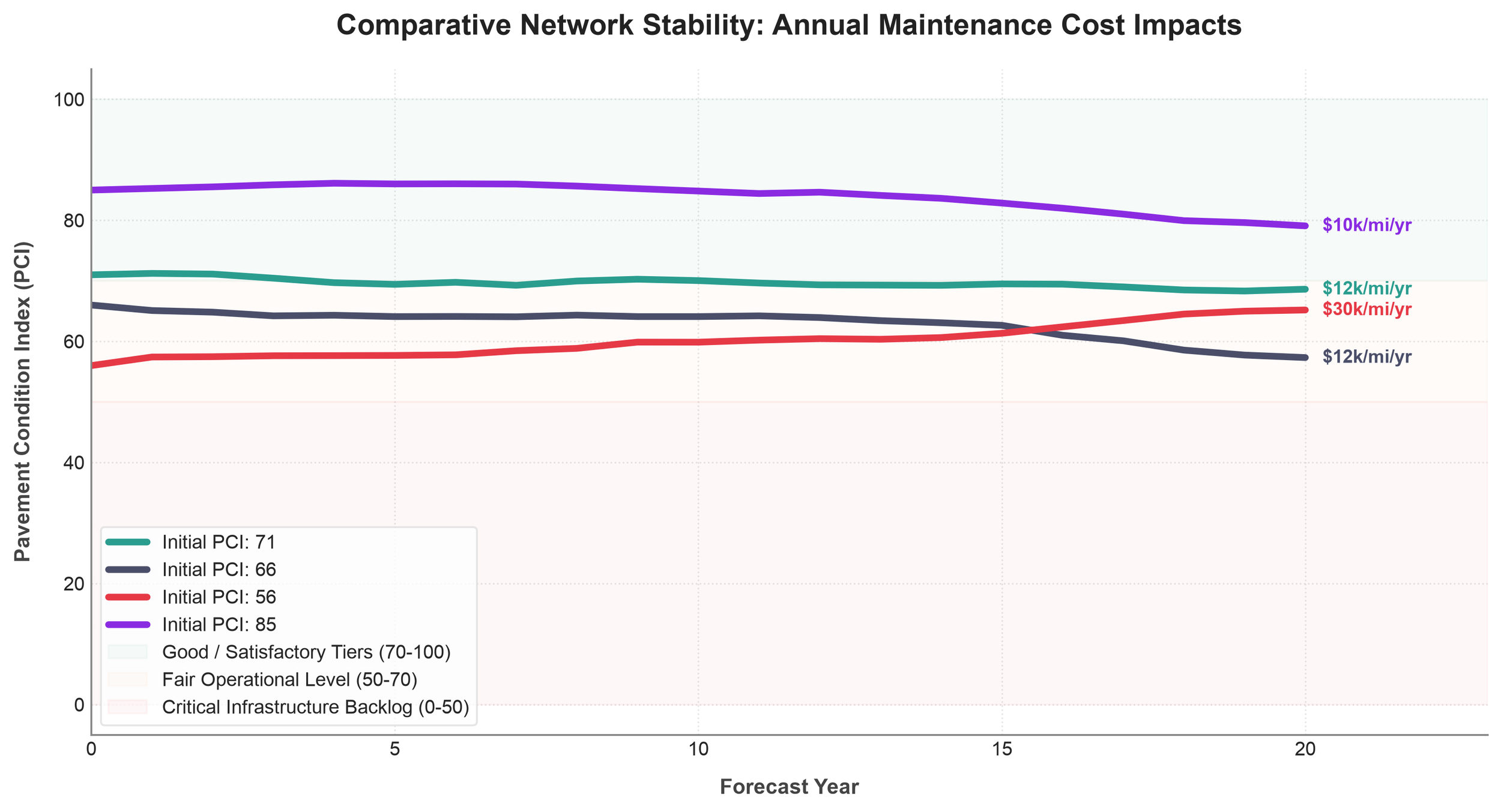
We calculated the hold-steady budget — the minimum annual spend needed to keep a city's average PCI from drifting, over a 20-year projection — for two networks sitting in what most people would call "good" condition: one starting at 66 PCI, another at 71.
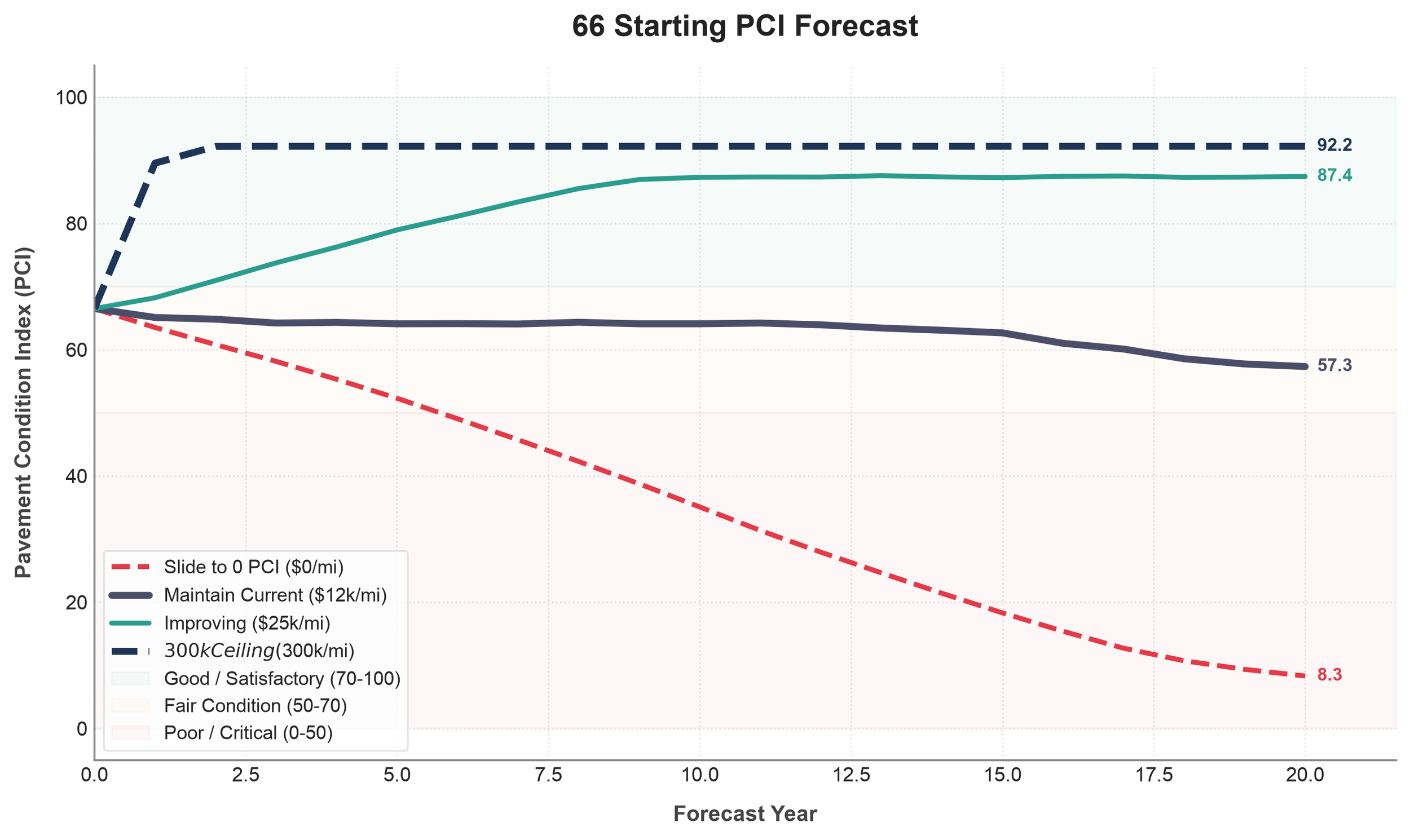
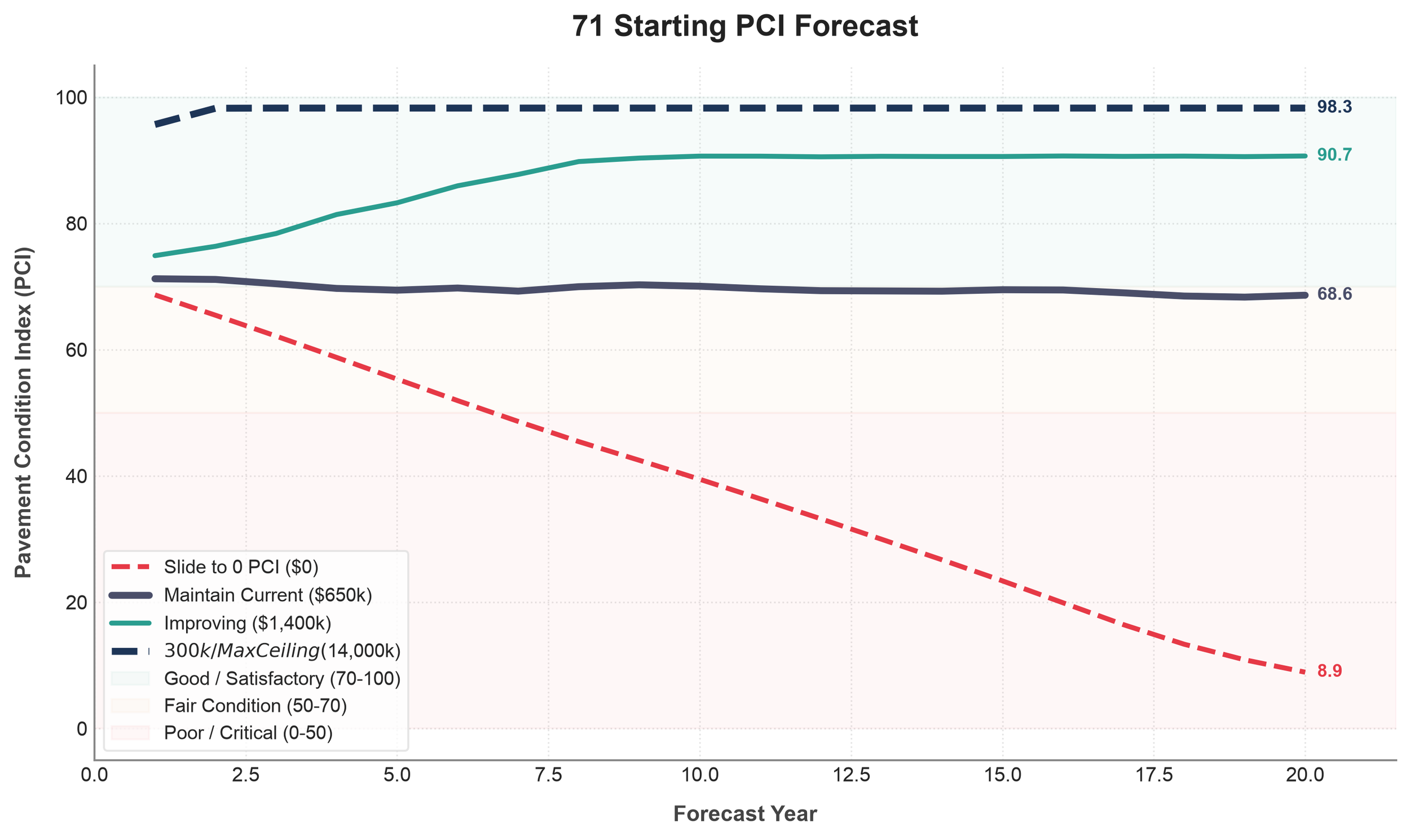
The results landed within a couple hundred dollars of each other: roughly $12,700 per mile per year for the 66 PCI network, and $12,670 for the 71 PCI network. Practically identical.
Then we checked a network sitting considerably higher, at 85 PCI.
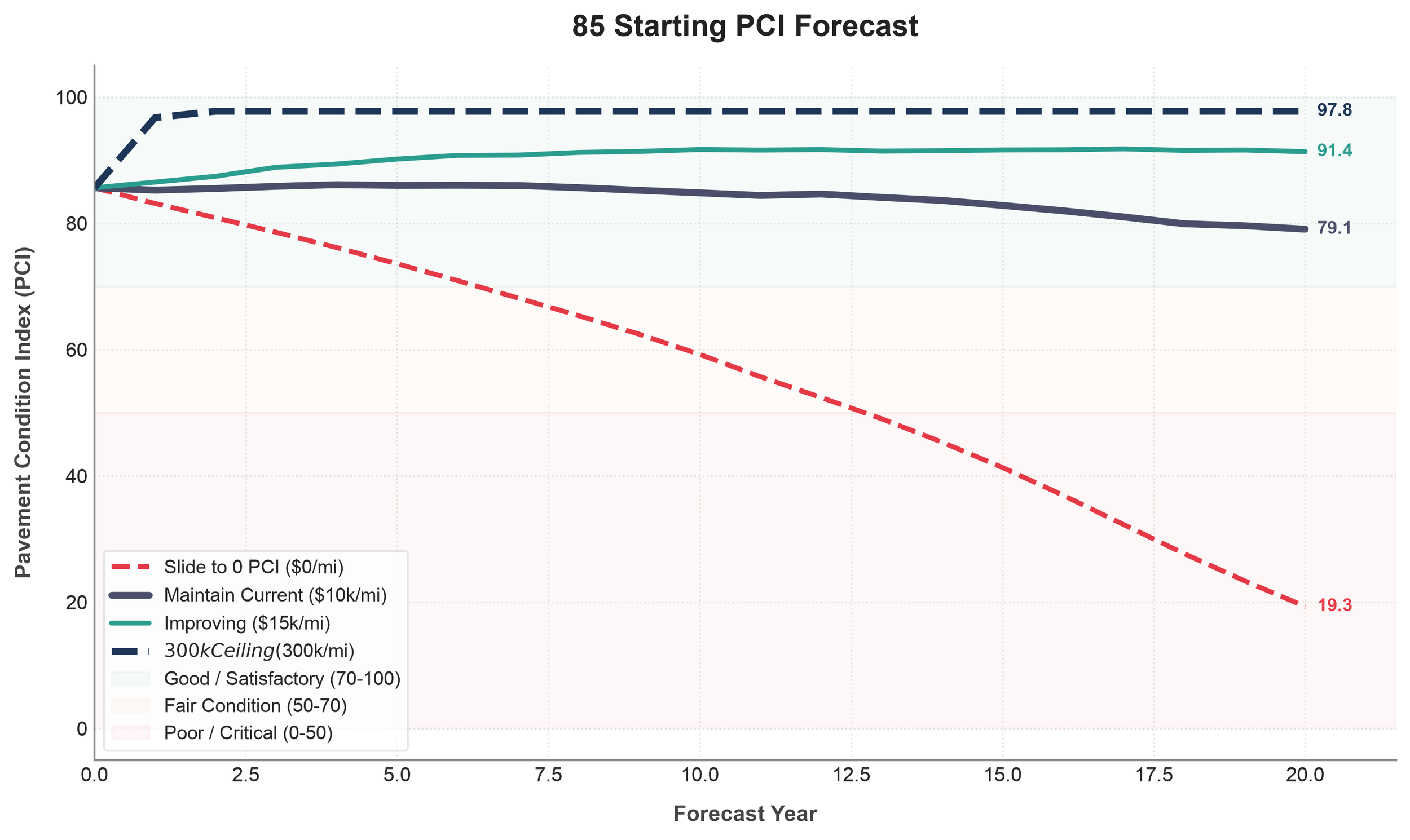
Its hold-steady number: $11,100 per mile per year, also in the same neighborhood.
In other words, anywhere from the high 60s through the mid-80s, the budget required to simply hold your ground barely moves. A network doesn't need to be in great shape to be cheap to maintain. It just needs to be on the right side of a line.
The cliff
Then we ran the same calculation for a fourth city, sitting at 56 PCI.
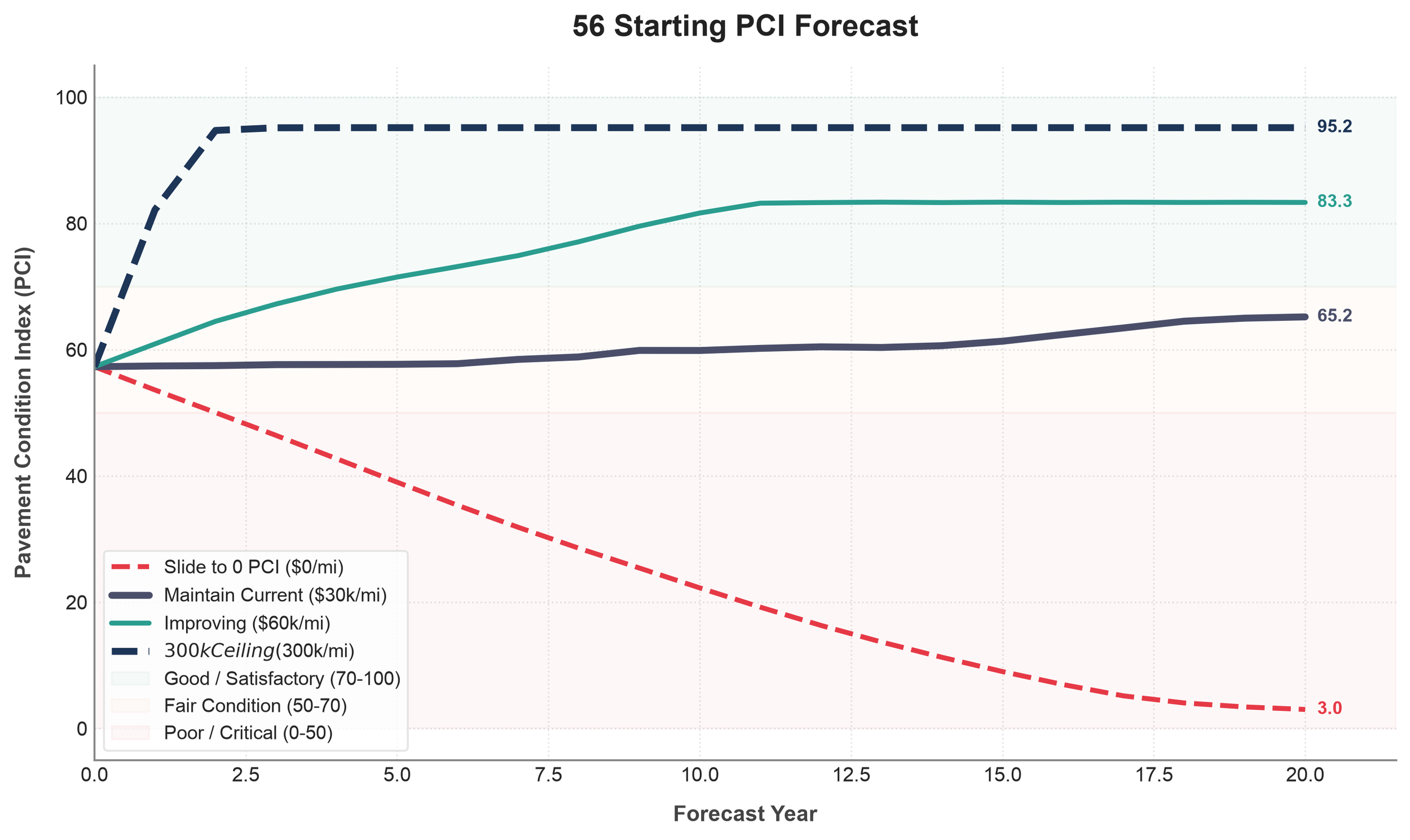
Its hold-steady number: $24,300 per mile per year, roughly double what it costs networks sitting 10 to 30 points higher. And holding steady at 56 isn't much of a prize to begin with. If the real goal is to climb back above 70, the budget required jumps again, to somewhere in the range of $36,000 to $40,000 per mile per year.
Why the line exists
This isn't a smooth, continuous relationship, it's a step function, and the step falls at a specific condition threshold in most treatment strategies, including ours. Above roughly PCI 70, a single low-cost preventive treatment can be applied across the board, and it stays cost-effective the whole way up into the high 80s and beyond. Below that line, preventive treatment alone isn't enough. The road needs something more involved, and more expensive, just to arrest the decline, let alone reverse it.
That threshold is why a 66 PCI network and an 85 PCI network cost about the same to maintain, while a 56 PCI network costs twice as much. The 66 and 85 networks are both above the line, eligible for the same low-cost toolkit. The 56 PCI network is on the wrong side of it.
The takeaway
The moral here isn't "high PCI is cheap, low PCI is expensive", it's narrower, and more actionable than that: there's a specific line, and which side of it you're on matters more than exactly where you sit relative to it. A network at a comfortable 75 isn't meaningfully cheaper to maintain than one at 85. But a network that slips below that line, even by 10 or 15 points, isn't just a little more expensive to hold onto. It's paying double just to stand still, and considerably more than that to climb back out.
If you don't know which side of that line your network is on, that's the first thing worth finding out — before you set next year's budget, not after.
Don't know your city's current PCI? That's the first thing we figure out in a GoodRoads Pavement Management Plan — so you're working from real numbers instead of guesswork. Reach out if you want to see what that looks like for your network.