
What Cities Are Doing About Utility Cuts
Not necessarily. The FHWA's Manual for Controlling and Reducing the Frequency of Pavement Utility Cuts — yes, this is a real document, and yes, it is exactly as niche as it sounds — lays out a toolkit of approaches cities have used to manage the problem. Here's a rundown of what's actually being tried.
Better Trench Standards
The most direct approach is requiring higher-quality repairs. Two common upgrades:
T-Patches. Instead of a simple rectangular patch matching the trench width, the repair is widened at the surface with a small milling machine into a T-shape. This creates a wider bond area between new and old pavement, reducing the jarring joint and giving the patch more structural support. It costs more, but it holds up better.
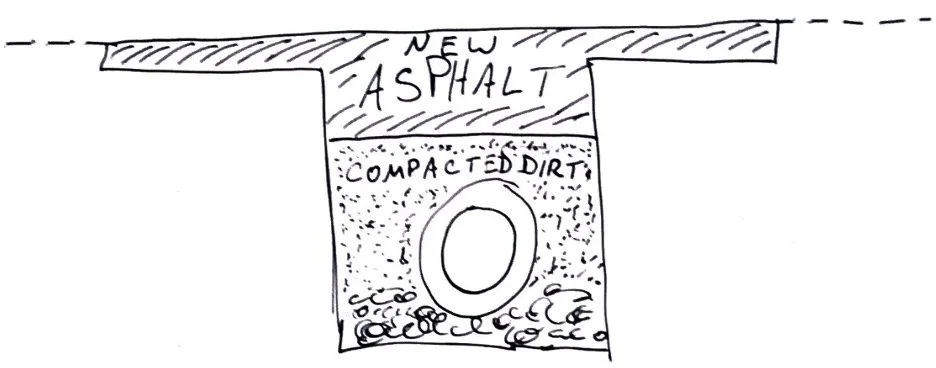
Sketch of a T-Patch above a utility repair
Full-lane repaving. Some cities go further and require the utility to repave the entire lane where the trench was cut, not just the trench itself. This eliminates the visible joint entirely and produces a much smoother result. It's significantly more expensive for the utility — which is part of the point.
In order to do either of these, cities need to have a good working relationship with utilities. I hear from a lot of cities that utility companies (or other city departments) are able to come in and tear up the road whenever they want, wherever they want. If this is your city, the first step is getting on the same page with utilities. This probably starts with a meeting with the utility’s leadership and your city’s leadership. And it involves enforcing trench standards, inspections, and warranty repairs.
Degradation Fees
Rather than micromanaging repair specs, some cities charge utilities a flat fee for every cut they make — a "degradation fee" meant to offset the long-term damage to the pavement. In theory, this creates a financial incentive for utilities to minimize unnecessary cuts and invest in better repair methods.
In practice, it's hard to calibrate. Every cut is different, and the right fee for a two-foot patch on a recently-resurfaced collector road is very different from the right fee for a trench in an already-deteriorated alley. Cities that have tried this often find the formula is more art than science.
Proactive Coordination
This is the approach that actually works best and it doesn't require fees or mandates, just communication.
The idea is simple: if a city knows it plans to resurface a road in the next one to two years, and a utility knows it has aging infrastructure in that same corridor, they should coordinate. The utility does its maintenance work before the resurfacing. The city resurfaces over a clean, properly repaired trench. Everyone wins.
This sounds obvious, but it requires both parties to know their plans and share that information. Most cities and utilities have asset management systems of varying quality, the gap is usually in talking to each other. Cities that establish regular coordination meetings with their major utilities, even informally, tend to see fewer post-resurfacing cut conflicts.
Moratoriums on Recently-Paved Roads
Cities like New York City and Perris, California have formalized the coordination incentive by banning utility cuts on recently-paved roads for a set period, typically three to five years.
If a utility absolutely must cut into a moratorium road (say, a water main bursts), they can, but they're required to repave the entire street, not just the trench. That's a significant cost, and it focuses minds upstream.
Encroachment Permits (Ending Blanket Permits)
Many cities offer utilities "blanket permits" a standing authorization to work in city streets with minimal notice or review. Or if the utility in question is another city department, there’s often a default blanket permit. The upside is speed: a utility can respond quickly to a service issue without bureaucratic delay. The downside is that it removes the city from the loop. Inspectors don't see the work, standards can slip, and the city has no chance to flag conflicts with upcoming paving projects.
Some cities have responded by eliminating blanket permits entirely. Every utility cut requires an individual encroachment permit, which means the city reviews the plan, can flag coordination opportunities, and can assign an inspector to verify that compaction and patching meet city standards before the trench is closed. It slows things down for the utility but the quality of repairs tends to improve.
Trenchless Technologies
The best utility cut is no utility cut. Trenchless technologies have advanced significantly and are increasingly practical:
Jack and bore uses a horizontal drill to install a new pipe without any surface excavation. The drill can be steered around existing underground utilities. It's more expensive than open cutting, but it preserves the road entirely.
Micro-trenching, pioneered in the US by Google Fiber, cuts a narrow slot in the pavement surface itself sometimes only an inch or two wide and installs conduit directly in the pavement layer rather than in the subgrade below. This dramatically reduces the repair area and, when done well, produces a nearly invisible patch.
The Common Thread
Most of these approaches come back to the same thing: communication and planning. Utilities and cities operate on different timelines, with different asset management systems, and often without regular dialogue. When they do talk and when they share their capital improvement schedules with each other, a lot of unnecessary damage simply doesn't happen.
That's not a technological solution. It's just good coordination. Which, in infrastructure management, turns out to be the hardest part.
---