
Why Do Utilities Live Under Our Roads?
Part 1 of 3 in a series on utility cuts
We all know them. We feel them every day. Those bands of newer-looking pavement running straight through your lane on the morning commute, just rough enough to rattle your coffee. They're called utility cuts — and love them or hate them, they're not going away.
But before we get into what's wrong with them and what cities can do about it, it's worth asking: why are utilities under our roads in the first place?
Utilities Are Kind of Amazing
Let's take a moment to appreciate what we're talking about. Modern utilities give us:
Clean, safe drinking water (in most parts of the US)
Electricity for lights, appliances, and gadgets
Natural gas for heat — and the hot shower, arguably one of civilization's finest achievements
The internet
Sewers, which quietly spare us from dealing with an enormous amount of, well, you know
Storm drainage that keeps streets from flooding every time it rains
These things are easy to take for granted until they stop working. And when they stop working, someone has to dig a hole.
Dry vs. Wet: Two Worlds Underground
Not all utilities are the same, and where they live depends on what they do.
"Dry" utilities. Electricity, cable, and internet often travel aboveground on utility poles. Utilities prefer this because overhead lines are easier to access and maintain. Urban planners tend to disagree: poles are unsightly, can be hazardous near roads, and sometimes create ADA issues on sidewalks. But that's a fight for another day.
"Wet" utilities. Water, sewer, gas, and storm drainage — run underground in pipes. There's really no alternative. You're not putting a gas main through someone's living room.
A quick note on storm drainage: it used to be called "storm sewers" because street runoff was once combined with actual sewage in the same pipes. As cities grew, treating all that runoff like sewage became prohibitively expensive — and a public health hazard when storms caused overflows. Most cities eventually separated the two systems, though some older ones are still working through that costly retrofit.
So Why Under the Roads?
If wet utilities have to go underground, where do they go? You could put them under sidewalks, or in the narrow strip of land between the sidewalk and the curb (called the planting strip). Cities sometimes do exactly this. But there are real problems:
Tree roots. Tree roots are relentless, and they love moisture — which means they love pipes. Sewer and water lines are a favorite target. The planting strip, with its mature street trees, is often the worst place to run a pipe you'd like to stay intact.
Space. That strip of land behind the sidewalk might be two feet wide. Fine for a small conduit; useless for a trunk sewer line.
And honestly, there's a philosophical logic here: utilities that serve the public should share the right-of-way with the roads that also serve the public. This is not a new idea. In the ancient Roman city of Pompeii, the streets literally were the sewer:
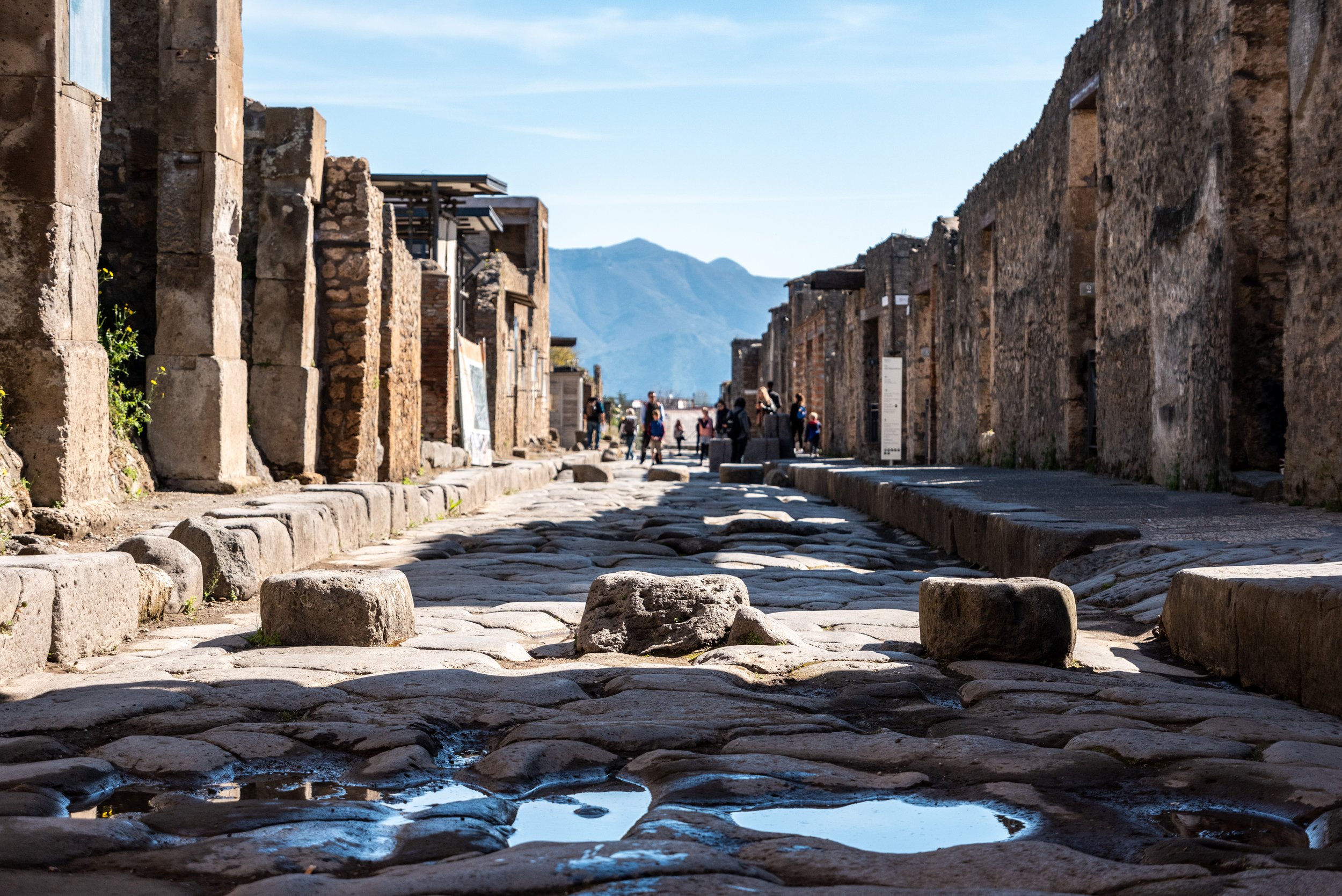
In Ancient Rome, chariots drove through stone-lined channels carrying runoff and waste, with stepping stones at intersections for pedestrians.
We've come a long way. Sort of. But one thing is still the same for both storm drains and sewers: these are the only two wet utilities that are not pressurized, so they follow this wise little engineering principle:
“S*** flows downhill.”This can severely limit the design choices engineers have because they must always maintain a continuous downhill flow. (Consider that as you hit those annoyingly-place sewer manholes right in the center of the wheelpath - perhaps the engineer had no choice)
The Unavoidable Truth
Utilities need maintenance. Underground utilities require excavation. And if the utility is buried under a road, that excavation goes through the road.
Cities have some control over how disruptive this is — and some surprisingly clever policies to manage it. But first, it helps to understand why utility patches tend to look and feel so rough, even when the repair crew did everything right.
That's next!
Next up: Why Do Utility Cuts Wreck the Road?
If you’d like to learn more tips and tricks for pavement management or need expert advice on navigating utility coordination, we’re here to help. Reach out to the team at GoodRoads—let’s build better roads together!